

New Orleans was founded officially in 1718 by Jean-Baptiste Le Moyne de Bienville, a French Canadian explorer and colonial administrator. Bienville chose a crescent-shaped bend in the Mississippi River for the new settlement, a location that would eventually become the heart of one of America’s most distinctive cities.
But why was New Orleans founded here, in a place surrounded by swamps and vulnerable to flooding? The answer is the Mississippi River. The location may not have seemed ideal for building a city, but the river offered something far more important: a direct transportation route into the interior of North America.
Why New Orleans Was Founded on the Mississippi River
When the French were establishing their colony of Louisiana, they wanted a settlement that could take advantage of the Mississippi River and help control trade through the region. There were other locations under consideration, and one of the most interesting alternatives was Manchac.
Manchac had an advantage that the future New Orleans site did not: it was on somewhat higher ground. It could also be reached from Lake Pontchartrain, which lies north of present-day New Orleans. From the lake, boats could travel through the Rigolets, a natural passage connecting Lake Pontchartrain with Lake Borgne and the Gulf of Mexico.
On a map, Manchac had plenty going for it. But it wasn’t on the Mississippi River.
That was the deciding factor. The Mississippi was essentially the superhighway of early North America. It provided a direct route between the Gulf of Mexico and the vast interior of the continent, allowing goods and people to travel by water much farther inland than they could from a settlement located away from the river.
Bienville understood the importance of that location. The land was low and difficult, but being directly on the Mississippi gave the new settlement enormous potential as a port and trading center.
Who Founded New Orleans?
The man most closely associated with the founding of New Orleans is Jean-Baptiste Le Moyne de Bienville. Born in Montreal in 1680, Bienville was part of a prominent French Canadian family of explorers involved in France’s efforts to establish a colony in Louisiana.
His older brother, Pierre Le Moyne d’Iberville, played an important role in exploring the Gulf Coast and establishing the French presence in Louisiana. Iberville died in 1706, however, so it was Bienville who selected the site for New Orleans in 1718.
Bienville was not a teenager when New Orleans was founded, as the story is sometimes told. He was an experienced explorer and colonial administrator in his late 30s.
The new settlement was named La Nouvelle-Orléans, or New Orleans, in honor of Philippe II, Duke of Orléans, who was serving as regent of France for the young King Louis XV.
How Did the French Quarter Begin?
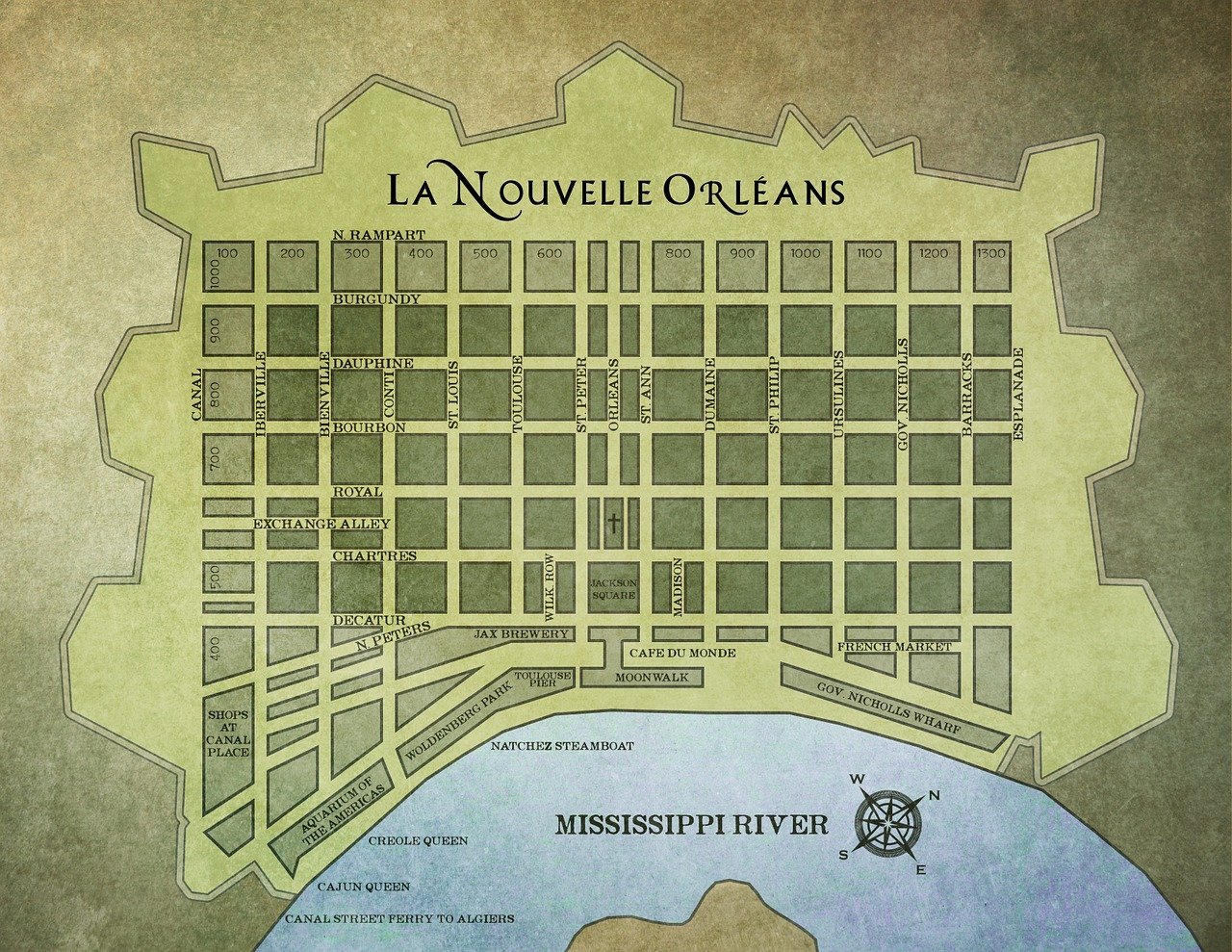
The original settlement eventually became the neighborhood we know today as the French Quarter, or Vieux Carré, meaning “Old Square.”
The streets were laid out in a compact rectangular grid. That original plan is one of the remarkable things about New Orleans because much of it is still visible more than three centuries later.
At the riverfront was a central public square called the Place d’Armes. Today, that same square is known as Jackson Square, one of the most recognizable places in New Orleans.
Some of the original French street names have survived as well. Chartres, Royal, Bourbon, Dauphine and Toulouse are still familiar names throughout the French Quarter.
So when you’re walking through the Quarter today, you’re not simply wandering through an old neighborhood. You’re following a street plan that goes back to the earliest days of New Orleans.
Why Did New Orleans Become So Important?
Bienville’s decision eventually proved to be a very good one. The Mississippi River made New Orleans an important port connecting the Gulf of Mexico with the interior of North America.
As the United States expanded westward, the river became increasingly important to commerce. New Orleans grew from a small French colonial settlement into one of the most important ports in the country.
The city would later pass from French to Spanish control before becoming part of the United States through the Louisiana Purchase of 1803. But through all those changes, the basic reason for putting New Orleans where it was never changed.
The city was founded because of the river.
More than 300 years later, that original decision is still easy to see. The Mississippi curves around the city. The French Quarter still follows the basic pattern of the original settlement. Jackson Square still faces the river.
New Orleans has changed enormously since 1718, but its location still tells the story of its beginning. Jean-Baptiste Bienville saw the Mississippi as the key to the future of the French colony, and his decision created the city we know today.
